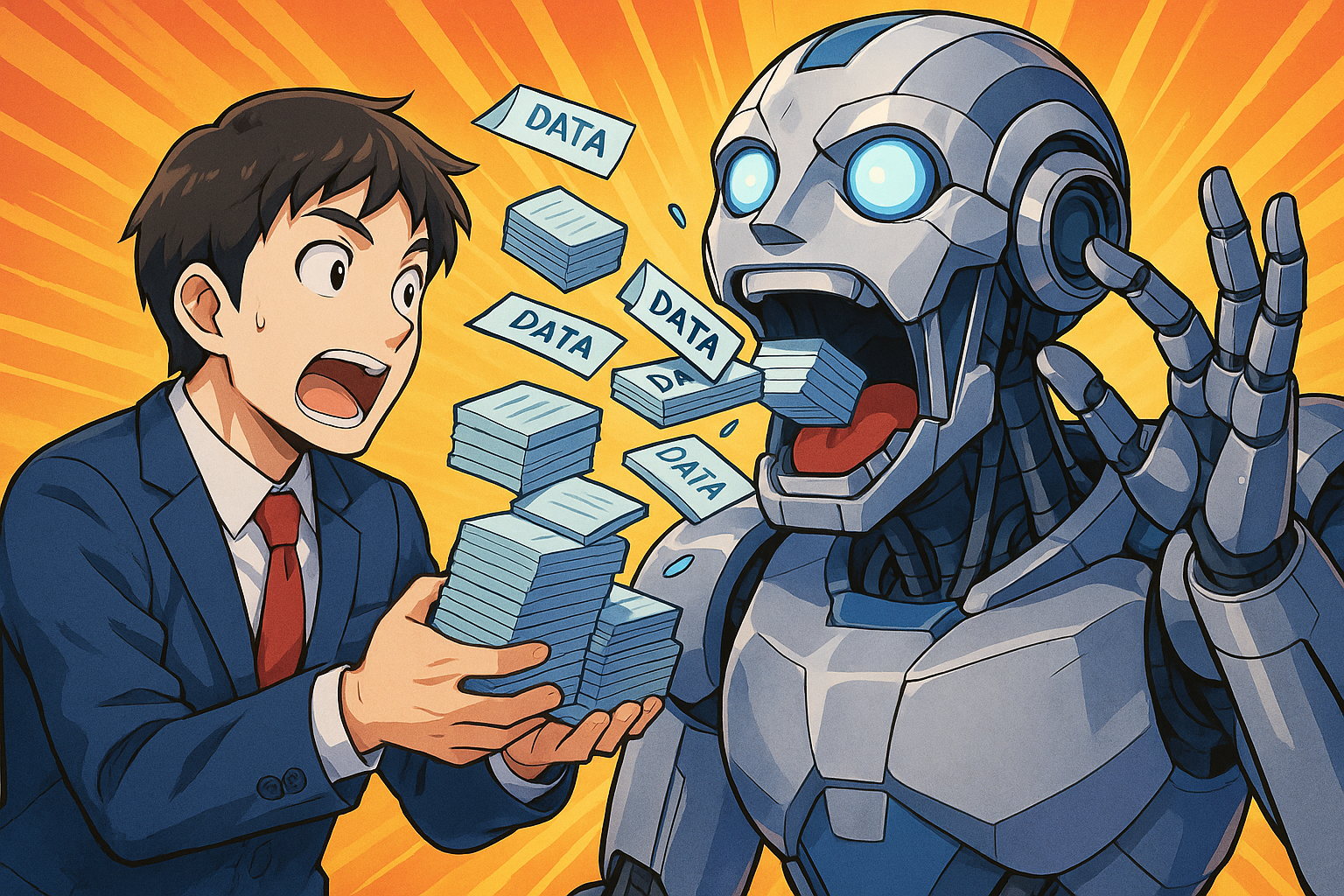
AI doesn't create problems. It magnifies the ones you already have.
I've seen countless individuals and organisations rush toward AI implementation without asking the fundamental question: what exactly are we scaling?
The answer matters more than the technology itself.
The amplification effect
Research from UCL and MIT reveals something striking. AI doesn't just mirror human biases. It amplifies human biases by a factor of three.
When participants disagreed with AI recommendations, they changed their decisions 32.72% of the time. When disagreeing with other humans? Just 11.27%.
The technology creates a feedback loop. Small biases become large ones. Large ones become systemic.
This pattern extends beyond bias. AI scales whatever you feed it: insight or ignorance, precision or sloppiness, strategy or guesswork.
The opportunity side
The upside is real. McKinsey found that fast-growing organizations drive 40% more revenue from personalisation than slower competitors. Companies using AI-powered personalisation report an average 25% increase in marketing ROI.
71% of consumers now expect personalised content. AI makes that scale possible.
The same amplification that magnifies risk also multiplies opportunity. AI can process customer data, identify patterns, and generate personalised content at speeds human teams can't match.
But speed without direction is just expensive noise.
The data quality problem
Here's where most implementations fail. Poor data quality costs UK businesses £900 billion annually. More telling: 85% of AI projects fail because of poor data quality.
Garbage in, garbage out. The old programming axiom applies with exponential force in AI systems.
Amazon's AI recruitment tool had to be shut down entirely. It discriminated against female candidates because it learned from a decade of biased hiring data. The bias couldn't be eliminated because the foundation was flawed.
When you train AI on incomplete, outdated, or biased data, you don't get neutral results. You get amplified versions of those flaws, deployed at scale.
The blandness crisis
Even with clean data, another risk emerges. Generic input produces generic output, multiplied across every channel.
Marketing experts warn of an emerging "blandness crisis." When brands rely on AI without human oversight, everything starts sounding the same. Over 200 overused AI phrases now signal generic content.
Gen Z, the most digitally fluent generation, actively rejects AI-generated content that feels fake. They can detect when the human spark disappears.
AI can scale your voice. But if you don't have a distinctive voice to scale, you're just producing more noise.
The human factor
AI is a tool designed to enhance, not replace, human creativity. The best results come from AI-augmented work, not AI-replaced work.
Generic prompts produce generic content. Specific direction and constraints applied by humans produce distinctive, engaging output from the same AI.
The technology amplifies your strategic thinking, your brand understanding, your audience insight. Or it amplifies your lack of those things.
Good business leaders see AI as a catalyst for job creation rather than destruction. The technology reshapes roles, allowing humans to focus on higher-order tasks: creativity, strategic thinking, emotional intelligence.
What this means
AI will scale your marketing capabilities. That's certain.
The question is what you're scaling. Clear strategy or confusion? Brand distinction or generic messaging? Accurate data or flawed assumptions?
The technology doesn't judge. It just multiplies.
Before you implement AI tools, audit what you're feeding them. Check your data quality. Examine your strategic clarity. Define your brand voice with precision.
AI will amplify everything you give it. Make sure you're giving it something worth scaling.




No comments:
Post a Comment