I've been in enough boardrooms to know what happens when marketing presents their monthly report.
The CMO walks through slides showing click-through rates, social media engagement, and website traffic. The numbers look impressive. The graphs trend upward.
And the CEO nods politely while thinking about revenue targets.
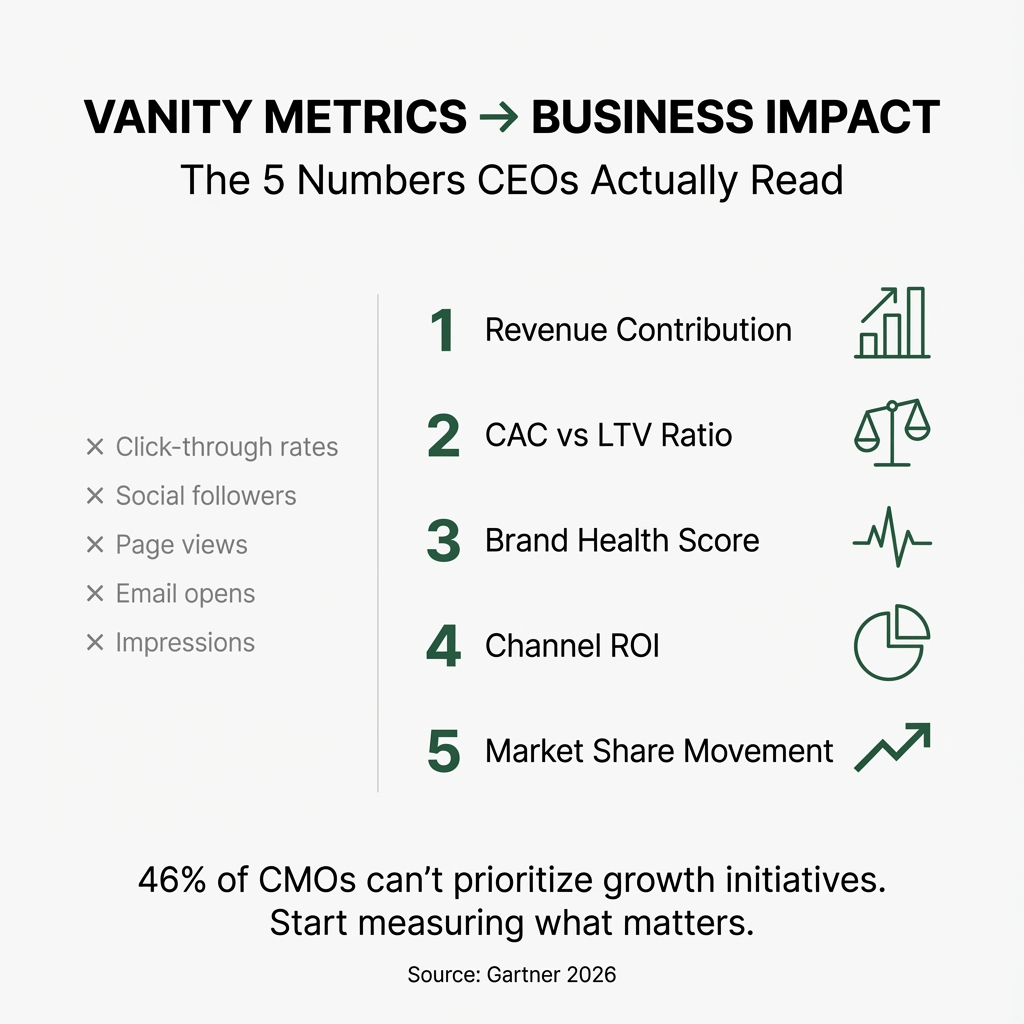
This disconnect isn't new, but it's getting worse. According to Gartner's 2026 research, 46% of CMOs identify their most urgent question as how to prioritise marketing initiatives most likely to drive growth. Meanwhile, 63% cite budget and resource constraints as their top challenge.
The pressure is real. The stakes are higher. And the old reporting playbook isn't working.
Why traditional marketing metrics fail in the boardroom
Here's what I've learned after two decades building marketing strategies: the metrics marketers love and the metrics CEOs need are often completely different.
Your CEO doesn't care about your click-through rate. They care about whether marketing is contributing to the company's ability to hit revenue targets, expand market share, and improve profitability.
The numbers tell the story. Just 14% of CEOs and CFOs view their CMO as highly effective at market shaping, according to Gartner. Yet companies with CMOs who are considered market shapers are more than twice as likely to exceed revenue and profit goals.
That gap? It's a trust problem. And it starts with how we report.
CFOs want clear proof of ROI. They speak the language of contribution margin, customer acquisition cost, and lifetime value. When you present vanity metrics that can't connect back to these core business objectives, you're speaking a different language entirely.
The vanity metric trap
Let me be direct about what qualifies as a vanity metric: any number you can't connect back to a core business objective.
That includes:
Social media followers (unless you can prove they convert)
Page views (unless they correlate with pipeline)
Email open rates (unless they drive measurable action)
Impressions (unless they build brand equity that translates to business outcomes)
These metrics feel good. They're easy to track. They often trend upward, which makes for nice presentations.
But they don't answer the question your CEO is actually asking: "Is marketing helping us grow the business?"
The most significant red flag of a vanity metric is simple. You can't draw a line from that number to revenue, profit, or market share. If the metric goes up but business results stay flat, you're measuring the wrong thing.
What CEOs actually want to see
I've watched this shift happen in real time. The conversation in 2025 moved decisively away from attribution obsession and toward business impact.
As one industry analysis i saw on LinkedIn put it: "Brands stopped obsessing over perfect attribution and started focusing on directional impact: sales uplift, contribution, and business outcomes."
This is the measurement shift that matters.
Your CEO wants to know:
How much revenue did marketing influence? Not just last-click attribution. The full contribution across the customer journey. Research shows that brands using advanced analytics report 5–8% higher marketing ROI than competitors. That advantage comes from better measurement, not better creative.
What's our customer acquisition cost relative to lifetime value? This ratio tells the story of sustainable growth. If you're spending £500 to acquire a customer worth £300, the math doesn't math.
How is brand health tracking against business performance? Data from over 7,000 consumers about 11,000 customer-provider relationships I saw showed a statistically significant correlation between brand health and sales. The healthiest brands have twice the amount of customers reporting increasing spending compared to the worst-performing brands.
What's the return on marketing investment by channel? Not vanity metrics by channel. Actual contribution to pipeline and revenue. This enables strategic reallocation decisions.
How are we performing against market share targets? Marketing exists to build brand salience and capture market position. If your reporting doesn't connect to this objective, you're missing the point.
The integration of qualitative and quantitative data
Here's where most marketing reports get it wrong. They focus exclusively on quantitative metrics while ignoring the qualitative signals that predict future performance.
Brand health matters. A lot.
Healthy brands get more attention, generate more trust, and convert more efficiently. That translates to lower acquisition costs, better margins, and stronger long-term customer value. If your brand is doing its job, your marketing spend works harder.
The qualitative metrics that belong in your CEO report:
Brand awareness and consideration trends
Net Promoter Score and customer satisfaction
Share of voice in your category
Brand perception against key competitors
Customer sentiment analysis from reviews and feedback
These aren't soft metrics. They're leading indicators of business performance. When brand health declines, revenue follows. When consideration increases, conversion rates improve.
The key is connecting these qualitative signals to quantitative outcomes. Show the correlation. Demonstrate how improvements in brand perception translated to pipeline growth. Prove that increased share of voice preceded market share gains.
Building reports that drive strategic decisions
The best marketing reports don't just present data. They enable decisions.
Think about it this way. Your CEO doesn't want a history lesson. They want actionable intelligence that helps them allocate resources and adjust strategy.
This is what strategic reporting looks like:
"Given these ROI figures, we plan to reallocate £100K from underperforming channels to the top two drivers next quarter."
That sentence turns your report into a springboard for strategic choices. It's exactly what the C-suite wants.
Research shows that 83% of high-performing marketers have the executive team's complete commitment to their marketing strategy. That's 2.6 times more than what underperforming teams report. You earn that commitment by demonstrating business impact through metrics that matter.
The measurement shift that happened in 2025 was cultural, not just technical. Measurement became shared infrastructure for finance, marketing, and analytics teams. It stopped being a retrospective reporting layer and became a strategic business function.
The practical framework for better reporting
You need a reporting structure that works for both marketing operations and executive strategy sessions.
Here's the framework I use:
Executive summary (one page maximum)
Revenue contribution and pipeline impact
ROI by major channel or campaign
Key performance trends (up or down, with context)
Strategic recommendations based on the data
Business impact metrics (the core section)
Customer acquisition cost and lifetime value
Marketing-influenced revenue and pipeline
Conversion rates by stage and channel
Market share movement and competitive position
Brand health indicators
Awareness and consideration tracking
Brand perception and sentiment
Share of voice analysis
Customer satisfaction and NPS trends
Channel performance (with context)
ROI and contribution by channel
Cost efficiency trends
Performance against benchmarks
Optimisation opportunities identified
Strategic implications and next steps
What the data tells us about strategy
Recommended resource reallocation
Tests and experiments planned
Expected impact on business objectives
This structure answers the questions your CEO is actually asking. It connects marketing activity to business outcomes. And it positions marketing as a strategic function, not a cost center.
Making the transition
Changing your reporting approach isn't just about new dashboards. It requires a shift in how you think about measurement.
Start by auditing your current metrics. Ask yourself: "If this number improves but revenue stays flat, does it matter?" If the answer is no, you're tracking a vanity metric.
Work with finance to align on definitions. Marketing-influenced revenue means different things to different people. Get clear on the methodology. Agree on attribution models. Establish shared KPIs that both teams understand and trust.
Build the infrastructure to track what matters. You need systems that connect marketing activity to pipeline and revenue. You need brand tracking that measures perception and salience. You need analytics that show contribution, not just correlation.
This takes time. It requires investment. But the alternative is continuing to present reports that don't resonate with the people who control your budget.
The competitive advantage of better measurement
Companies that get measurement right move faster and allocate resources more effectively.
When you can clearly demonstrate which marketing initiatives drive growth, you earn the trust and budget to do more of what works. When you can show how brand health predicts future performance, you make the case for long-term investment.
The measurement maturity shift isn't about perfection. It's about moving from retrospective reporting to strategic intelligence. From vanity metrics to business impact. From marketing language to executive language.
Your CEO doesn't need to understand marketing tactics. But you need to understand business strategy. The metrics you choose to report signal whether you see marketing as a creative function or a growth driver.
The gap between what marketers measure and what executives need is closing. The agencies and marketing leaders who adapt their reporting to focus on business impact will earn the seat at the strategic table.
The ones who keep presenting click-through rates and social media engagement will keep fighting for budget and credibility.
The choice is yours.
What this means for your next board presentation
Before you build your next marketing report, ask yourself one question: "Would our CFO find this data useful for making resource allocation decisions?"
If the answer is no, you're reporting the wrong metrics.
The pressure on marketing to prove value isn't going away. Budget constraints are real. The expectation that marketing directly contributes to growth is only intensifying.
You can respond by defending your vanity metrics and explaining why engagement matters. Or you can shift your measurement approach to focus on the metrics your CEO actually cares about.
Revenue contribution. Customer acquisition efficiency. Brand health that predicts future performance. Market share movement. ROI that enables strategic decisions.
These are the numbers that matter. These are the metrics that earn executive commitment. These are the reports that position marketing as a strategic function.
The measurement infrastructure exists. The frameworks are proven. The competitive advantage goes to the marketing leaders who make the shift.
Your next board presentation is an opportunity to demonstrate that you understand what the business needs from marketing. Not just creative campaigns and tactical execution, but measurable contribution to growth objectives.
The metrics you choose to report tell a story about how you see marketing's role. Make sure it's the right story.




No comments:
Post a Comment